
Founded by Romane and inspired by the heirloom rings of her great-grandmother, the brand reimagines a timeless piece with contemporary clarity. Each creation balances heritage with innovation moving beyond the old social codes once associated with pinky rings, the jewelry now asserts a quiet, confident modernity.
Every piece is handcrafted between the Parisian atelier and artisans in Jaipur, the global epicenter of gemstones. From 3-micron 18k gold-plated brass to meticulously set fine stones, the brand’s attention to detail ensures that elegance is tangible, durable, and precise. The result is jewelry for those who value refinement over instant gratification—a modern heirloom, born of history, executed with intention.

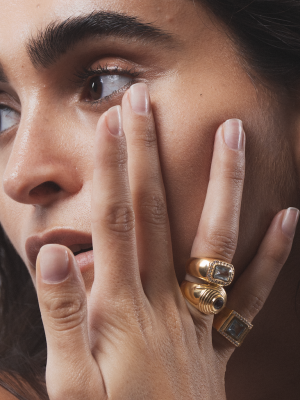

THE CURALIST: Hi Romane, welcome to The Curalist! I wanted to start by talking a little about your journey, because I believe it is an integral part of your story and the identity of your brand.
ROMANE : Hi Alice, thank you for the invitation. I’m very happy to be talking with you today. Jewelry has always been part of my world. I grew up surrounded by the pieces my grandmother and great-grandmother passed down to my mother precious, semi-precious, costume jewelry, all mixed together in some kind of chaos. In my family, jewelry is meant to circulate, to be borrowed, shared, and handed down. Everything began when I inherited one of my great-grandmother’s signet rings. That ring became the starting point of Irene d’Arloz because it’s very elegant to have something to wear on the pinky finger, it’s very expressive. At the time, it wasn’t a common and popular, but signet rings still carried strong social codes. Inspired by my great-grandmother Irène’s pieces, I began sketching my first collection with the desire to strip the signet ring of its traditional connotations. I imagined a contemporary, timeless signet, a modern heirloom, one that my great-grandmother, my grandmother, my mother, my sister or my closest friends would all feel drawn to wear.
THE CURALIST: A signet ring traditionally carries a strong identity. In your work, what does it represent?
ROMANE : In my work, a signet ring carries no prescribed identity. It is cherished for its beauty, its elegance, and the nostalgia it evokes for jewelry of a bygone era not for what it once represented. I believe certain vintage pieces deserve to be neutralized, much like religious medals, which have now become widely depersonalized. That’s precisely what I love in my creative process: taking objects once laden with meaning and reinventing them freely, wiping the slate clean of their past connotations, and preserving what truly matters their beauty, meant to adorn our hands, our necks, and elevate the everyday.
THE CURALIST: Signet rings have long been associated with a male heritage. For you, how important was it to reinvent this piece with a feminine and familial perspective?
ROMANE : The signet ring I inherited from my great-grandmother, the one that inspired my first collection was originally a man’s ring that she had resized. Because of that, I never really separated men’s and women’s signet rings in my research. To me, jewelry is inherently unisex; boundaries have long been blurred. And Irène, my great-grandmother, had understood that long before any of us did.
THE CURALIST: You mentioned working with a Parisian atelier to produce your rings. What does that collaboration look like on a day-to-day basis?
ROMANE : My prototypes are developed in a workshop in Le Marais, and the series are then entirely handmade in India, in a small atelier with exceptional craftsmanship. I take great pleasure in working with these different collaborators. I learn so much from them, from the dialogue between their skills and from the way these talents come together.
THE CURALIST: Could you tell us more about the materials and techniques you use for your rings? What are the non-negotiables when it comes to production?
ROMANE : My jewelry is handmade in gold-plated brass or 925 sterling silver, set with semi-precious stones. To me, it’s the ideal balance a way to come close to fine jewelry while keeping prices accessible. With proper care, these pieces can last a lifetime, and in doing so, carry forward the tradition of transmission that exists among the women in my family, into other families. That’s what moves me most. I often have clients who gift my signet rings to their sisters, mothers, or daughters. Those moments create a real sense of closeness with my clients, and I truly love that.
THE CURALIST: What are your plans for the future? Can you imagine where you’d like to see Irene d’Arloz in five years?
ROMANE : I think what I enjoy most is precisely not projecting myself too far ahead. I’m currently launching a new collection with signet rings, but also necklaces. It came quite spontaneously. My creative process is rather instinctive, a little chaotic even. I hope to continue releasing new collections regularly, while remaining a human-scale brand. I want to keep offering handmade pieces it naturally limits expansion, but it’s what feels meaningful to me.